
Before You Build, You Need a Topographic Survey. Here’s Why.
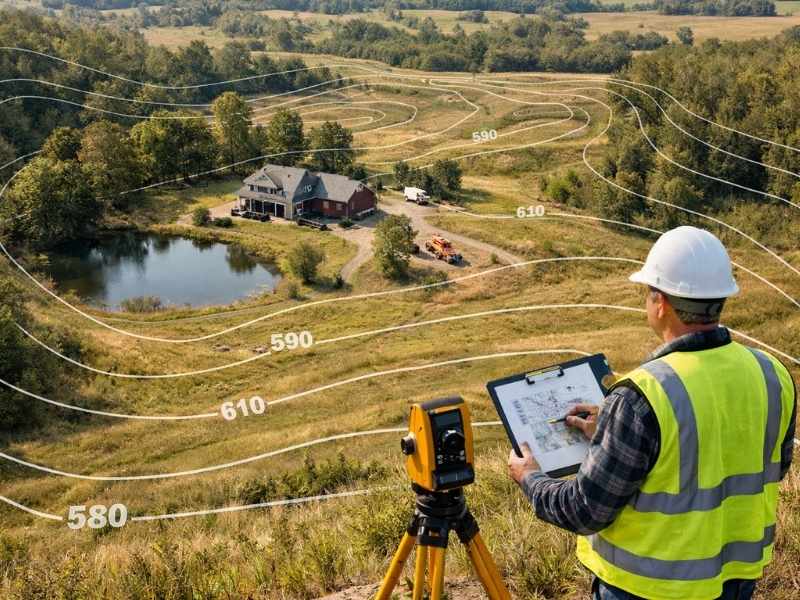
A topographic survey maps the physical shape of a piece of land, showing elevation changes, slopes, trees, drainage features, and existing structures. It does not establish who owns the property. Architects, engineers, and builders use it to design projects that work with the natural lay of the land instead of against it.
The Survey That Reads the Land
Most people think of land surveying as something that establishes property lines. That is true for some survey types, but a topographic survey does something different. Instead of asking “where does my property end,” it asks “what does this land actually look like?”
This distinction matters. You can own a piece of land and still have no idea how it drains after a storm, where the high and low spots are, or whether a proposed building will sit on stable ground. A topographic survey answers all of those questions before any design work begins.
What a Topographic Survey Captures
When a surveyor completes a topographic survey, the final map shows two categories of information.
Natural features:
- Ground elevation across the entire site
- Slopes, ridges, and low spots
- Trees and significant vegetation
- Streams, ponds, wetlands, and drainage paths
Man-made features:
- Existing buildings and structures
- Driveways, roads, and walkways
- Retaining walls and fences
- Visible utility lines and drainage structures
All of this information is combined into a single map that your designer, engineer, or architect can work from directly.
How to Read a Topographic Map: Contour Lines Explained

The most important feature of any topographic map is the contour lines. These are curved lines that connect points on the land that share the same elevation. Once you understand what they mean, reading a topo map becomes much easier.
Here is the simple version:
- Lines that are far apart mean the ground slopes gently. The land is relatively flat between those two elevations.
- Lines that are close together mean the ground drops or rises steeply. A cluster of tight lines indicates a hill or a sharp drop-off.
- Circular lines typically indicate a hill or a depression, depending on the numbers shown.
Every contour line on the map is labeled with an elevation number. If one line reads 20 feet and the next reads 22 feet, the ground rises two feet between those two points. That kind of detail is exactly what a drainage engineer or foundation designer needs before work begins.
You do not need to be able to read the map yourself. Your surveyor, architect, or engineer will interpret it. But understanding the basics helps you ask better questions and follow along when your project team reviews the results.
When Do You Actually Need a Topographic Survey?
A topographic survey is not required for every project. However, skipping it when you do need one is a costly mistake. Here are the situations where one is either required or strongly recommended.
You Are Designing a New Home or Addition
Any architect designing a custom home needs accurate elevation data to make good decisions. The slope of the land affects where the home sits, how the foundation is designed, where water will flow away from the structure, and whether the driveway will work at a safe grade. Without a topo survey, these decisions are based on guesses.
You Need a Permit for Site Work
Many municipalities require a topographic survey as part of a grading or drainage permit application, especially for projects that affect how water flows across a property. In many cases, documented elevation data is required before a permit can be approved.
Your Property Has Drainage Problems
If your yard floods after heavy rain, or if water pools near your foundation, a topographic survey can identify exactly why. It shows where the land is channeling water and whether the existing drainage paths are working. That information is the starting point for any drainage correction plan.
Your Land Is Near a Floodplain or Waterway
Properties near rivers, creeks, bays, or wetlands often have complex elevation changes that affect both design and flood risk. A topographic survey provides the precise elevation data needed to evaluate flood exposure, satisfy FEMA requirements, and design responsibly in sensitive areas.
You Are Planning a Pool, Retaining Wall, or Major Landscaping Project
These projects change the way water moves across a site. A pool changes to an impervious cover. A retaining wall redirects runoff. Without knowing how the land sits before construction begins, these projects can create drainage problems that did not exist before.
What You Receive at the End
A completed topographic survey is typically delivered as a digital CAD file and a printed map. The map shows your property with all natural and man-made features plotted to scale, along with contour lines at a set interval.
Your design team uses this file directly. Architects load it into their design software. Civil engineers use it to calculate drainage volumes and design grading plans. Permit offices use it to verify that proposed site work meets local code.
Keep a copy of your topographic survey on file. If you make future improvements to the property, having the original topo as a baseline makes the next round of design work faster and cheaper.
What Happens If You Skip It?
Some property owners skip the topographic survey to save money upfront. This often costs more in the long run.
Without accurate elevation data, designers make assumptions. Those assumptions can lead to foundations that need to be re-engineered, drainage problems discovered mid-construction, permit rejections that delay your project, or grading work that moves water toward your home instead of away from it.
A topographic survey is not the most expensive part of any building project. Fixing design mistakes that result from skipping one almost always is.
Frequently Asked Questions
Is a topographic survey the same as a boundary survey?
No. A boundary survey establishes legal property lines and sets corner markers. A topographic survey maps the physical shape of the land, including elevation and features. They are often ordered together for new construction projects, but they serve different purposes.
Does a topographic survey show property lines?
A topographic survey may show the general outline of a property, but it is not a legal boundary document. If you need your property lines established or certified, a separate boundary survey is required.
How long does a topographic survey take?
Field work for a standard residential lot typically takes one day. Processing the data and delivering the final map usually takes an additional three to seven business days, depending on the firm’s workload.
Do I need a topographic survey if my land is flat?
Possibly. Even flat land has subtle elevation changes that affect drainage. Many permit offices require elevation documentation regardless of terrain type, especially in coastal and flood-prone areas.